

Traditional tests confirm.
Antithesis discovers.

Unleash your team.
Antithesis catches unforeseen bugs in minutes, so humans and agents can ship quickly without risking outages.
Prevent outages
By injecting realistic faults and leveraging our simulator’s unique replay capabilities, we explore the execution paths that even years of traditional testing miss.
Skip debugging
Our simulator is 100% deterministic and automatically root causes every bug. Rather than wasting time and tokens chasing flaky heisenbugs, your team can jump straight to a fix.
Ship faster
When every pull request has already survived the Antithesis gauntlet, your team can merge big changes confidently — even when they’re authored by agents.
4 steps to get started with Antithesis


Optimized for code verification

Deterministic down to the instruction stream
Our platform’s foundation is a custom deterministic hypervisor that runs your whole system on a single CPU core. We massively parallelize runs and fully utilize every core to get you results faster.
- Never fight another flaky test.
- Find rare, multi-factorial bugs in minutes.
- Instruction-level determinism works with any x86 binary.

Years of production experience in minutes
Our feedback-guided exploration algorithm synthesizes unusual input data and injects faults to actively increase test coverage, so no time is wasted blindly repeating the same scenarios. If your system survives our tailored torture regime, it will stay up in production.
- Simulate clock, scheduling, network, and storage faults with zero configuration.
- Exercise hard-to-reach code paths like exception handling and leader election.
- Prioritize exploration of particularly critical code.

Perfect reproductions are just the start
Especially in complex systems, identifying bugs is only half the battle: root causing them is often equally hard. Deterministic replay lets Antithesis replace hours of spelunking through logs with automated root cause analysis and interactive debugging.
- Get unified, perfectly ordered traces of distributed execution.
- Pull custom artifacts from your system, like data files or core dumps.
- Edges surfaced in minutes, not months
- Suspend execution, rewind time, and analyze your system as bugs occur.

Verification in the agentic loop
Our skills let you integrate Antithesis into your harness’s feedback loop, so your agent only declares victory once our platform has verified its output. While you’re just getting started, our skills also help with every step of onboarding. Have agents:
- Always produce battle-tested, correct code.
- Write Docker Compose or Kubernetes manifests for your system.
- Build a precise specification of your system’s expected behavior.
- Triage and debug for you.
Accelerating reliability for elite teams
What would otherwise take six months of testing in production, running the software -- we can get that in an hour.


The way Antithesis tests whole-system scenarios that we either wouldn’t have thought to test is its own kind of magic… we feel like we can tackle more ambitious projects by relying on Antithesis to fill in any gaps along the way.
Engineering output
Antithesis helped us find three key bugs in Tigris… These are the bugs that CI can't cover because no one thinks to write tests for them.


Honestly pretty impressed by this one. I basically dropped the Antithesis logs into Claude and had it debug + fix it end-to-end. Exactly what I want Antithesis to enable us to do.
in Antithesis covers more cases than 100 engineers
Antithesis’s deterministic simulation and active exploration removes the blindfold, enabling a systematic and reproducible search for bugs.

There’s been a transformation in the engineering group. With basically the same group of people, output is now significantly better. Antithesis has given us more confidence in what we’re delivering, lower stress development, more predictability… I look at Antithesis as a way of enabling us to scale, and that is just an enormous deal.


Compressed 3 weeks of debugging into one day
With Antithesis, you can make these pretty bold changes that ordinarily you would have to approach so carefully in order to do safely, and you can just kind of write the thing.

Good questions deserve straight answers.
How is Antithesis different from chaos testing?
How is Antithesis different from AI code review?
How is Antithesis different from the tests I already have?
How long does onboarding take?
What languages and stacks does Antithesis support?
What if my system uses Postgres, Kafka, or other dependencies?
Does Antithesis support multicast networking?
Can I buy Antithesis through the AWS Marketplace?
Does Antithesis offer an on-premise / VPC option?
Is there a free or open-source version of Antithesis?
Go deeper on the technology


Why we taught agents to break distributed safety properties
Using mutation testing to validate AI-generated test suites for distributed systems.
Free log storage with a time machine
Send all your logs into a black hole -- then pull them out again!
Ways research teams fail
A taxonomy of failure modes for research groups.
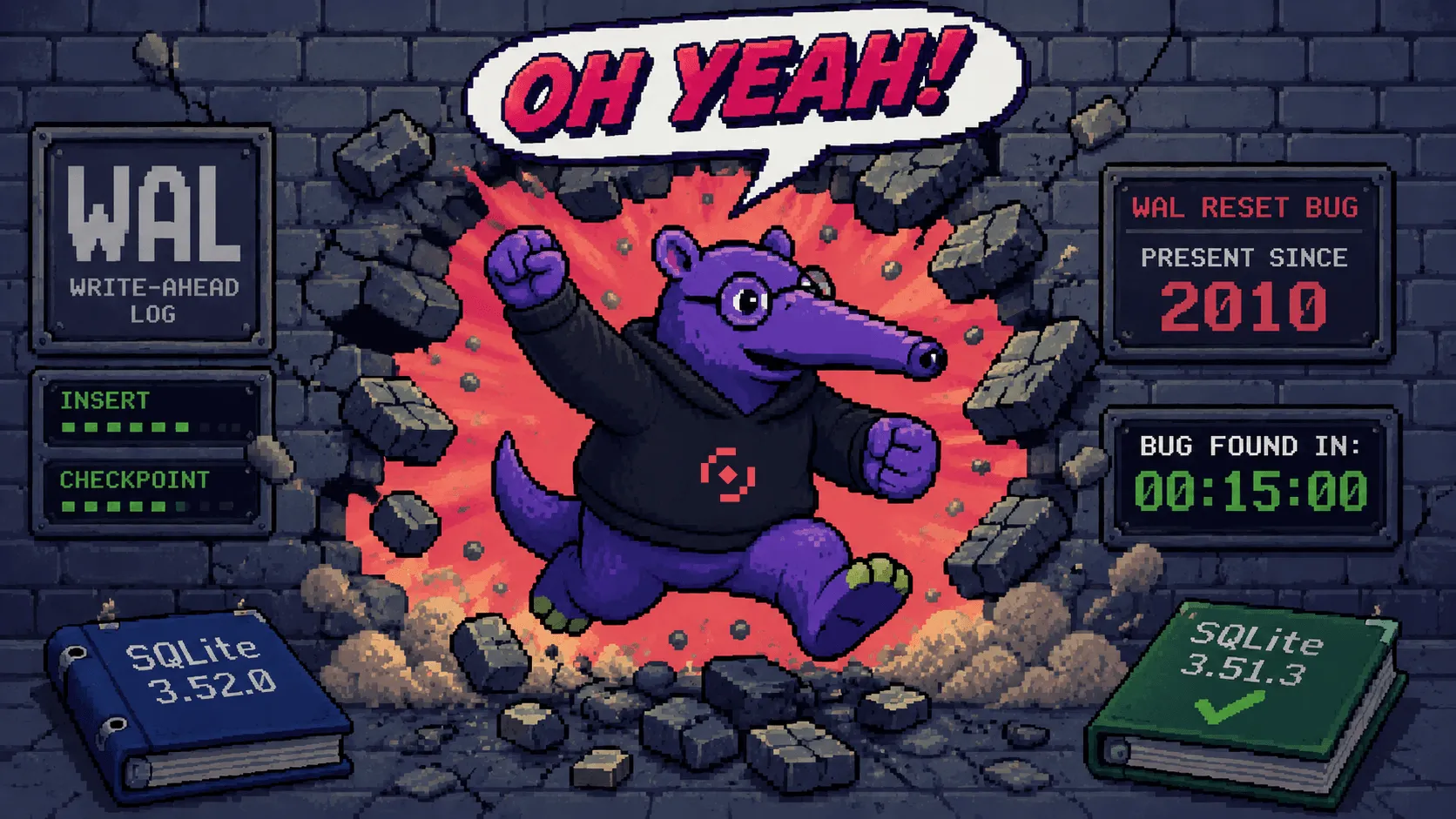
Breaking the WAL
I did this from a lawn chair on the Sunshine Coast.


